Edge Banding Machines
Automatic edge banders for cabinet and furniture makers. Seven models: a compact machine for a small shop, pre-milling and corner rounding for visible fronts, a 28 m/min production machine, plus laser and 45° bevel edge banders.
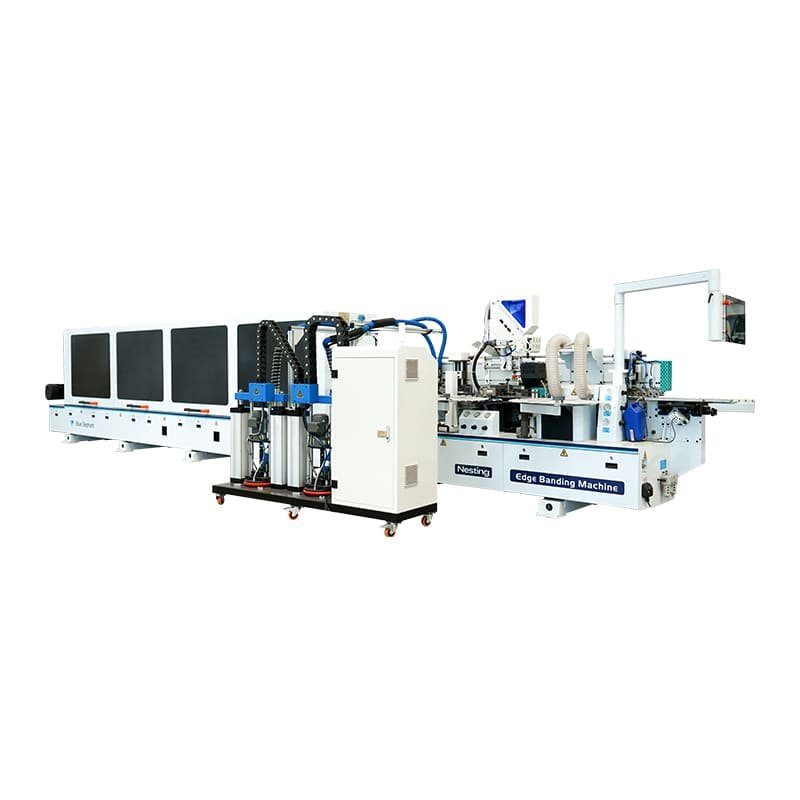
Start from the size of your shop
Most buyers end up with one of these three.
Small shop
First automatic edge bander, a few hundred edges a day.
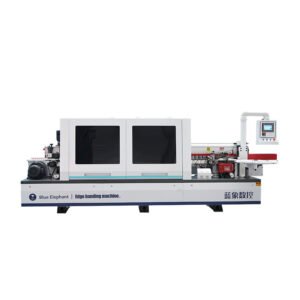 Compact Automatic Edge Bander
Six stations in 4.5 m. Glue, trim, scrape and buff without a second pass.
Growing shop
Doors and fronts on show, thicker tape, one operator.
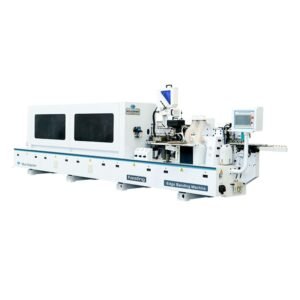 Edge Bander with Pre-Milling and Corner Rounding
Pre-milling gives a tight glue line and the tracking unit rounds every corner.
Factory
Banding all shift behind an automatic cutting line.
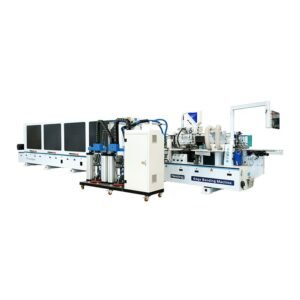 High-Speed Edge Banding Machine
Up to 28 m/min, with doubled trimming, scraping and buffing units.
All models side by side
Compact Automatic Edge Bander
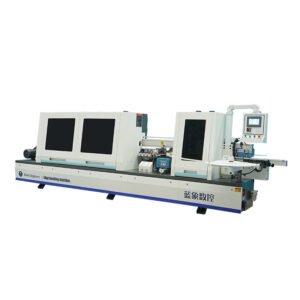
Edge Bander with Pre-Milling
Edge Bander with Pre-Milling and Corner Rounding
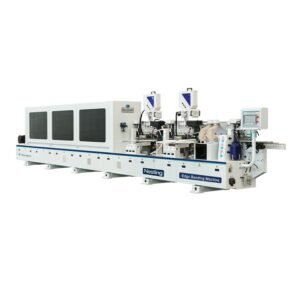
Edge Bander with Dual Glue Pots
High-Speed Edge Banding Machine
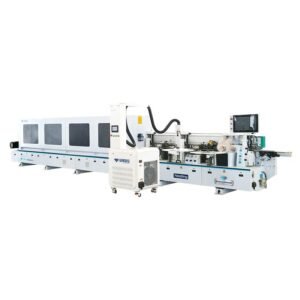
Laser Edge Banding Machine
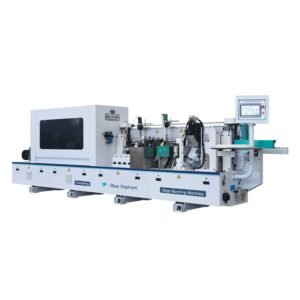
45° Bevel Edge Banding Machine
How an edge bander works
The panel rides through a row of stations on a track. Each station does one job on the edge as it passes.
-
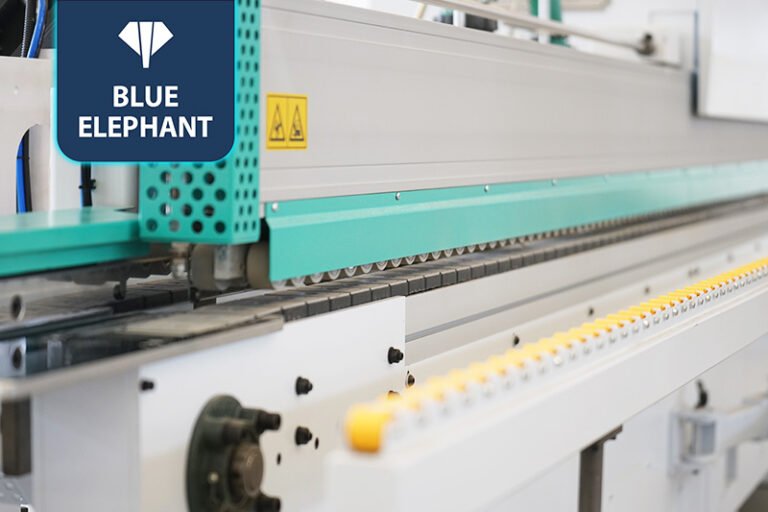
Feed
The panel is placed on the track and held down by a pressure beam.
-
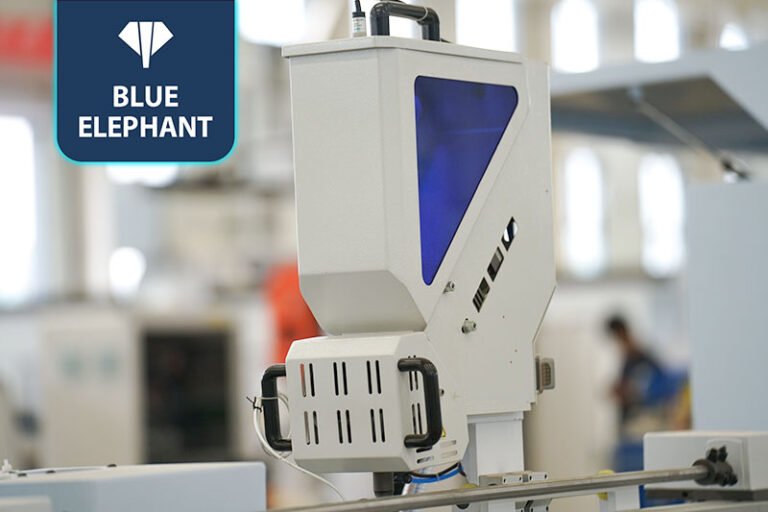
Glue
A roller applies an even film of hot-melt glue to the edge.
-
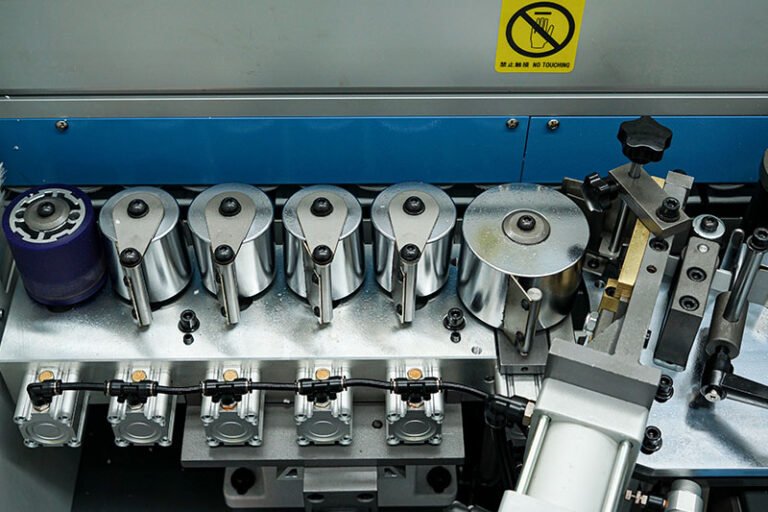
Press
Pressure rollers push the tape onto the glued edge.
-
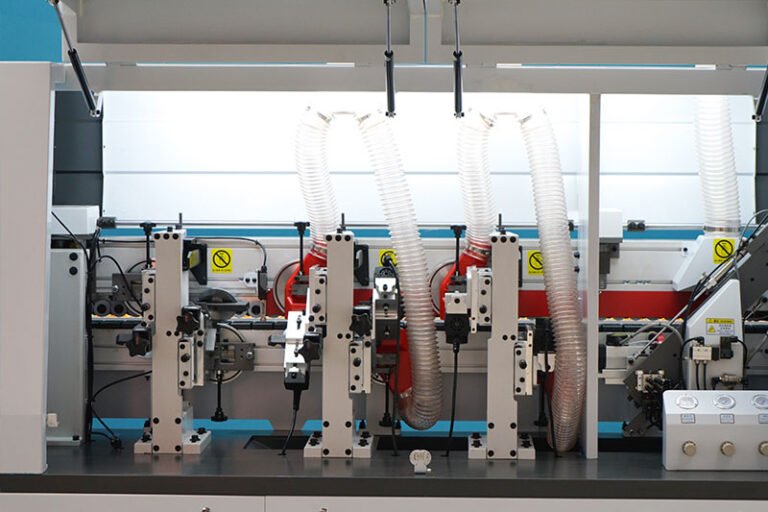
Trim and finish
The tape is cut flush, trimmed, scraped and buffed.
What each station does
Models differ mainly in which stations they carry. These are the ones you will see in the specifications.
| Station | What it does | Why it matters |
|---|---|---|
| Pre-milling | Mills a fresh, square edge just before gluing | Removes chips and saw marks, so the glue line is thin |
| Gluing and pressing | Rolls glue onto the edge and presses the tape on | Decides how strong and how visible the joint is |
| End trimming | Cuts the tape flush at the front and back of the panel | Clean ends without tearing the tape |
| Rough and fine trimming | Removes the tape overhang on the top and bottom | Leaves a small radius instead of a sharp lip |
| Corner rounding | Rounds the tape at the four corners of the panel | Doors and fronts need no hand finishing |
| Scraping | Scrapes away the ripple left by the trimming cutters | A smooth radius, most visible on thick tape |
| Buffing | Polishes the edge with cloth wheels | Brings back the colour and removes glue traces |
How to choose
- Edge quality of your cutting. If panels come off a saw or router with small chips, choose a model with pre-milling.
- Visible parts. Doors and drawer fronts with 1–3 mm tape need corner rounding. Carcass parts do not.
- Volume. Feed speed and doubled units matter once banding runs all shift. Below that, a shorter machine does the same finish.
- Colour changes. If you swap between light and dark edging daily, two glue pots save a cleaning cycle each time.
- Floor length. The range runs from 4.5 m to 10.6 m. Add space at both ends for feeding and stacking.
Where it sits in the line
Edge banding comes straight after cutting. Parts from a CNC nesting machine or panel saw are banded on every visible edge, then go on to side drilling. To see how the stations are sized against each other, try the cabinet line planner.
Common questions
What is the difference between an edge bander and an edge banding machine?
None. Both names describe the same machine. "Edge bander" is more common in North America, the UK and Australia, and "edge banding machine" elsewhere.
Do I need pre-milling?
If you band melamine or laminate-faced boards, yes in most cases. Pre-milling removes the small chips left by cutting and gives a thinner glue line. For raw MDF cut cleanly, a compact machine without it can be enough.
Which edging thickness can these machines apply?
Most models take tape from 0.4 mm to 3 mm. The bevel edge bander takes 1.0 to 2.0 mm. The range for each model is in its specifications.
EVA or PUR glue?
EVA hot-melt is standard and suits most furniture. PUR gives a thinner, moisture- and heat-resistant bond for kitchens and bathrooms, and needs a PUR glue system on the machine.
How many operators does an edge bander need?
Two as standard: one feeding and one stacking. With a return conveyor, one operator can do both.
Tell us about your project
Tell us what you make and roughly how many sheets you cut per day. We reply within one working day.
- What you get back
- A recommended configuration, FOB or CIF price and lead time.
- Useful to include
- Sheet size, board types, your power supply and any machines you already own.
- Want to see it first?
- Ask for a video call from the factory floor.